Tuesday, September 8, 2015

Leipzig

We've just spent five days at our "home away from home": Leipzig. We had another fine visit with Anita and Samy, and Anita's parents Annelore and Werner. Annelore was Les' first Esperanto penpal 29 years ago, and the whole family are dear friends.

We walked a lot in downtown Leipzig, went to an organ concert, saw an exhibition where Samy's talented 16-year-old daughter had been invited to display several paintings, and went to Annelore's house in Wölkau to eat four(!) different cakes she'd just baked.

View from Anita's home

With Anita at an exhibit on the history of printing, at the German National Library

With Anita, Samy, Annelore, and Werner, we spent a day in lovely Halle and in Eisleben, where we listened to nuns chanting in a cloister and went to the birthplace and deathplace of Martin Luther, both turned into museums, plus the church where he was baptized.

As we were thinking that Eisleben was a pretty serious town, with all its Martin Luther locations, we spotted these whimsical knitted chickens on fenceposts.

Just like when we were in Leipzig in July, we happened to hit the monthly meeting of Annelore's local Esperanto group. And just like last time, because it was a Monday evening, the streets were teeming with police cars to prevent trouble during the weekly immigration protests. One group objects to Germany letting in so many refugees, while the counter group objects to the Nazi-type sentiments of the first group. Fortunately, the counter-demonstrators outnumbered the antiforeigners by a large margin (20:1). I'm glad that Anita's son and his friends sometimes join the counter group.

Today we took the train to Lübeck in the north. We chose it as a well-located overnight place on the way to Denmark, and hadn't realized that it's actually a charming town worth visiting in its own right.

The Holsten Gate in Lübeck

We heard that Lübeck is famous for its marzipan, so we picked up a few kinds to test out how good it is.
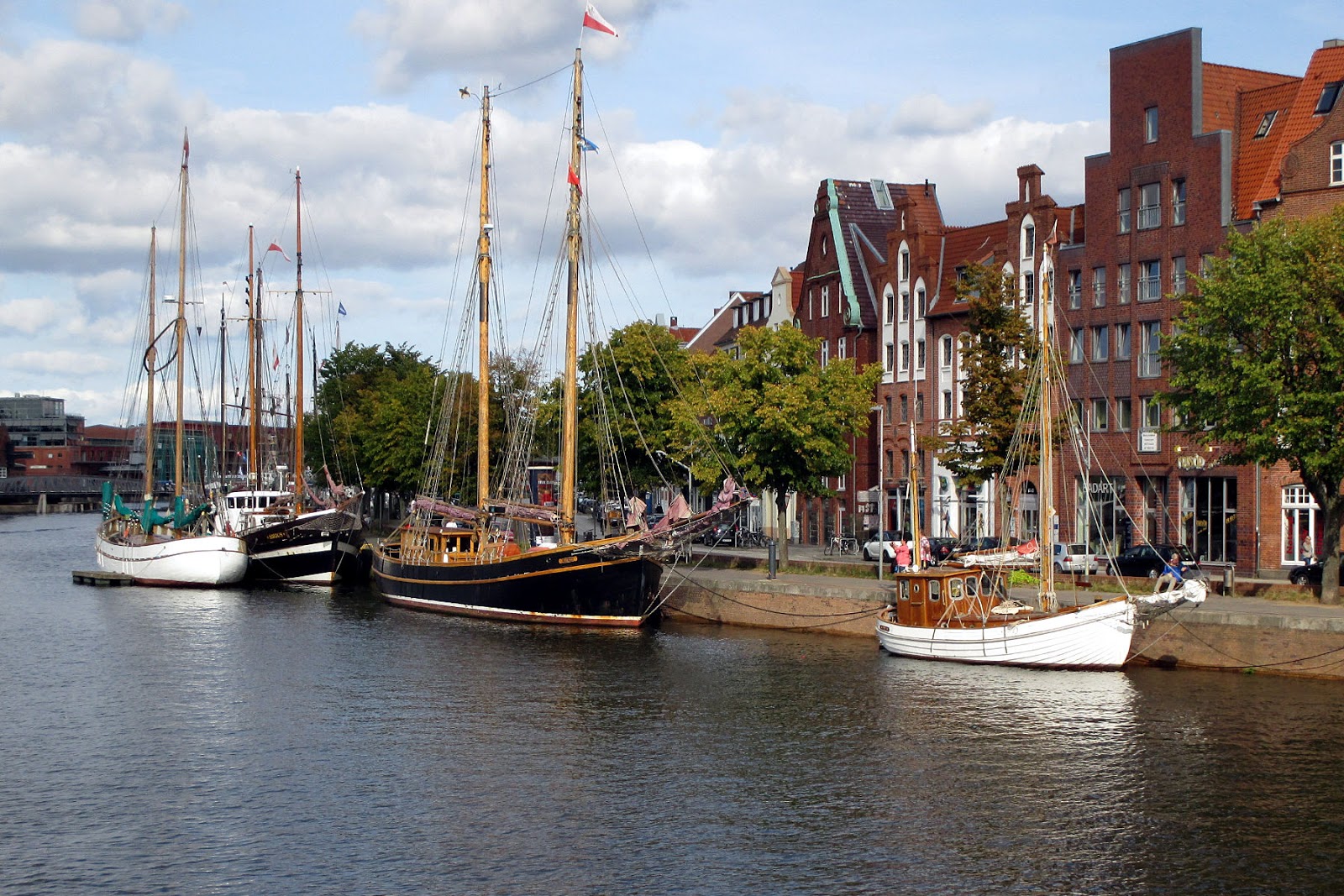
Lübeck's old town is an island

People have been asking us all summer what we plan to do about housing when we get back to Seattle. Will you get an apartment? Stay on the boat? Keep traveling? The answer has always been that we haven't really thought about it, are just enjoying each day as it comes without thinking of the future. But in the past few days we've come up with some ideas.

The first idea is to spend two or three months in Leipzig next fall. We would probably use Airbnb for housing. We didn't use it at all on this trip, but it seems reasonable to try, and that leads to a second idea; try out Airbnb in the U.S. and Canada this winter and spring. The plan I currently like is to alternate a month on the boat and a month in some other city, then back to Europe in the fall. We'll pursue these ideas after settling in at home. At the start of the year we had thought that we might spend this November and December in New Zealand, but Les feels he needs time to digest what we've already done, so probably that idea is out.

Tomorrow it's on to our last new country: Denmark.

Europe really is on the metric system—10 eggs instead of a dozen!

Friday, September 4, 2015

Switzerland - part 2

We had intentionally not made any plans for the last two and a half weeks of our trip. We wanted to stay flexible in case we heard about new opportunities. This plan worked out well, as we had a couple of invitations from people we didn't even know at the start of our trip. They helped determine our itinerary: Zurich, Leipzig (again) and Denmark.

After the Itala Kongreso we spent a night in Milan. There's currently an Expo there, but we don't like crowds, and it was quite hot, so we just spent our evening walking around town a bit.

The next day we went to Zurich, where we stayed two nights. We walked a lot, and we took advantage of an all-day transportation pass by going on a lot of trams and a boat and a funicular. Zurich is a nice, modern city, but we found it a bit sterile compared to Geneva and Bern.

Then we went a short distance to the village of Niederlenz, to stay with Udo, an Esperanto speaker we met at SES in Slovakia. This was out in the country, a different experience from the large cities and suburbs we'd visited so far in Switzerland. There were loads of trails through forests and rural areas. We got caught in a torrential downpour during one walk, as the hot weather pattern finally broke. The nearby town of Lenzburg was a tiny, perfect village, fitting well with Les' criteria for a good city: nice architecture, no graffiti, no honking, minimal smoking, people look happy.

Castle in Lenzburg

Udo teaches middle school (at least that would be the U.S. equivalent), and he gave me a tour of his school. When I expressed surprise at the school's bunker, Udo explained that every house and building must, by law, have a bunker where you can live for 24 hours. They're inspected periodically by the government. The idea is to protect from both enemy attack and accidents from the atomic energy plants. The bunker in Udo's basement looked very substantial. An alternative is to buy space in a nearby community bunker.

One feature of the school I liked was the hallway where each graduating student gets to paint a concrete block on the wall.

Bricks painted by graduating students

This reference to Esperanto was a surprise

The students get Wednesday afternoons off, which seems like a nice mid-week break for both students and teachers. And I love the annual school schedule in Switzerland. Instead of a long summer vacation, there are three-week vacations spread throughout the year. The kids have a total of 14 weeks off, but must choose one of those weeks to do a "project". The projects are offered by various instructors, and sound wonderful: photography, skiing, bicycling, etc. Udo has always taught amateur radio, but this year he's going to try a week of "Esperanto as a secret language".

When we mentioned how much outdoor smoking we found in Europe, Udo told us about a national contest that encourages students to abstain from smoking by offering monetary incentives to class units. Wow, what a great idea to use peer pressure to discourage smoking instead of the opposite.

As we left, Udo's wife Lena plied us with produce from her garden: apples, pears, tomatoes, grapes, tiny gherkins (so adorable, each one the size of a large blueberry). We greatly enjoyed our stay with Udo and Lena, and were glad to hear that Udo has added his name to Pasporta Servo so that other Esperanto speakers can enjoy a stay there.

The three trains to Leipzig took 12 hours, partly because we've changed our algorithm for choosing trains. For the first month or so of the trip, we chose routes where there might be seven minutes or so to make a connection. But I found it too nerve-wracking if the first train was running late, to think that we might miss the train on which we'd paid for a reserved seat, and perhaps not get any seat at all on a later train. So now we give ourselves at least 45 minutes between any trains, often longer. The extra wait can actually be quite pleasant when we're able to take advantage of the first class lounge.

Speaking of trains, I realize that even after taking so many trains, I'm still often baffled when I use the WC in them. It seems like every train, and every public bathroom, not to mention many private bathrooms, have various ways to flush, to get water, to get soap, to dry hands, etc. For example, the flushing mechanism might be on some part of the toilet, or some button on a wall, or a chain overhead to pull, or something even more mysterious. Even locking and unlocking the door is sometimes a puzzle; on two or three occasions I've wondered whether it might get down to shouting "Help!" in order to get out.

We're back in Leipzig now, our "second home" with Anita's family. Taking a breath before the final adventure in Denmark.